
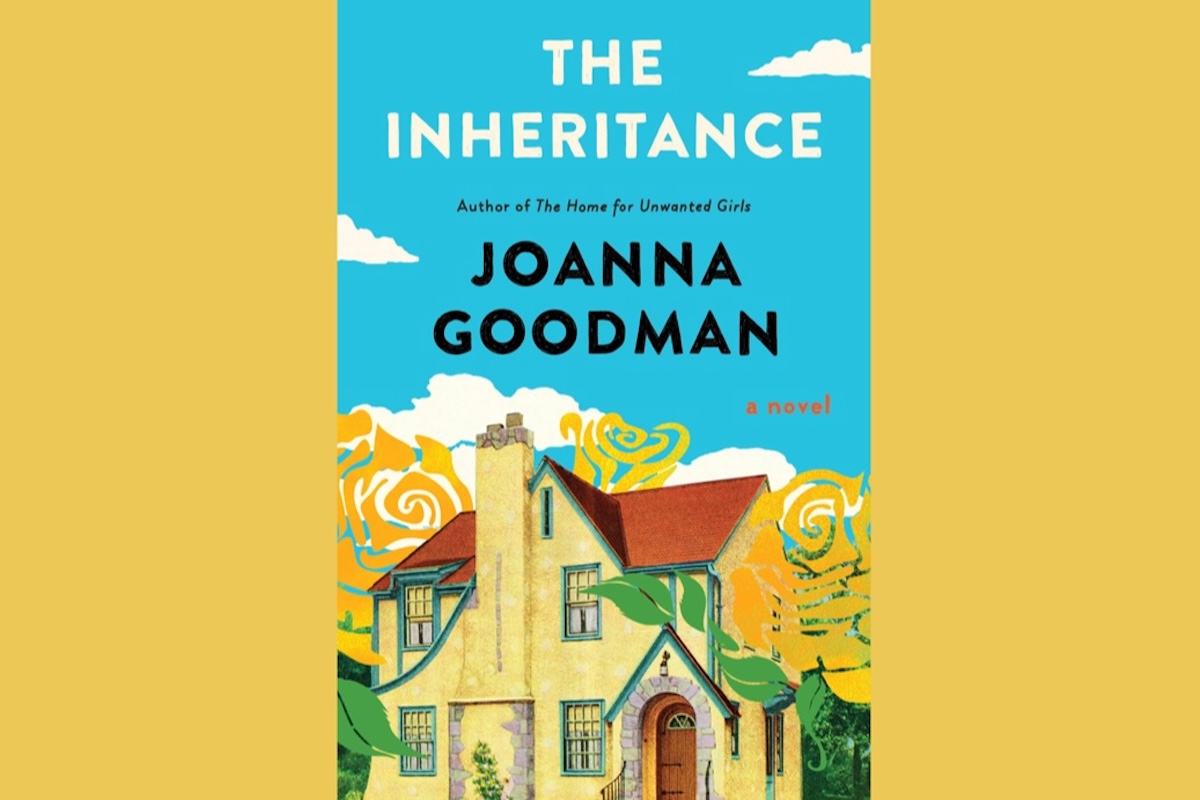
A strong gust of wind blows open the shutters with a bang, waking Arden from an already disturbed sleep. She blinks, blinded by a beam of light from the ill-positioned streetlight shining directly into her window. She looks over at her phone, which is upright in its dock. It’s al- most three o’clock. She gets up, closes the window, slips back under the duvet. Without even attempting to fall asleep on her own, she reaches into her bedside drawer and grabs a Sublinox. She swallows it with a glass of warm water and lies back down, waiting for the iron clamp of grief to loosen its grip.
Eventually, she falls into a thick, dreamless sleep. Next thing she knows there’s an elbow pressing into her lower back. As she slowly begins to come to, groggy and disoriented, she searches for Scott’s warm body in the bed. There’s a soft moan beside her. She opens one eye and gazes over at her sleeping daughter, remembering. Scott’s dead.
That’s when the tape starts rolling. Are we going to be okay? Are the kids going to be permanently damaged? Will I figure out life on my own? And then the more practical matters: Should I list the house? Should I take a second mortgage? Should I send Ivey to a shrink?
Arden forces herself awake to make it stop. She turns and looks over at Ali’s round, pink face. Her damp hair is fanned out around her, her left arm flung across Wyatt’s back, holding him close, the way they must have slept together in the womb. Her precious magpies. She touches his pull-up. It’s soaking wet. Almost seven years old and he’s back in pull-ups.
On the other side of Wyatt, Ivey is snoring, face skyward. Her chest rises and falls, her nose whistling softly with each exhalation. She’s at the edge of the mattress, long legs tangled up in the sheets. Arden reaches across the other two to touch Ivey’s cheek. The older she gets, the more she’s morphing into her father. She’s got the same dark brown eyes and heavy brow, the angular jawline and slightly cleft chin that Wyatt once called “an upside-down fortune cookie.” She rarely sleeps in here any- more, but every once in a while, she has a bad dream or gets lonely or misses her father, and she crawls in with them in the middle of the night.
Ali sits up abruptly, squinting and rubbing her eyes. Arden wordlessly hands her the wire-rimmed glasses that make her look so much older than six, kisses her forehead, and gets out of bed to shower. She’s going to New York to visit her stepdad, Hal. It’s her first time away from the kids since their father died a year and a half ago. Her sister, Tate, booked her a massage in Park Slope and got her two tickets to see a show on Broadway. Tate is spoiling her because she knows Arden is flat broke, and also be- cause she likes to think of herself as Arden’s savior.
Arden gets in the shower and lets the hot water wash away the cloudiness of the sleeping pill, the residue of dread. She tips her head back, her mouth opened wide so she can taste the water on her tongue. She stands there for a long time. Just as she’s starting to feel human again, the plastic curtain flies open, rattling the metal hooks on the rod, and there’s Ali, staring up at her. Arden throws an arm over her bare breasts and is immediately reminded of that morning when Ali barged in on her and Scott showering together. She was five and stood there gaping at Scott’s penis for an uncomfortable length of time, until he eventually grabbed a facecloth and shielded himself with it like it was a codpiece.
“What is that thing?” Ali asked him.
“That’s my wiener,” Scott responded, unprepared. How could you be? Ali squealed and ran away.
“Your wiener?” Arden said to him. “Really? That’s what you’re going with?”
Scott shrugged and let the washcloth fall to his feet. That turned out to be the last conversation he ever had with his youngest daughter other than the perfunctory goodbye he called out to them before he left to go back to the cottage. Arden wonders if Ali will wind up in therapy one day, sobbing on a shrink’s couch over the fact that her father’s last words to her were That’s my wiener.
“Mommy?” Ali says, her glasses fogging. “Please don’t leave.”
“It’s just for two nights, darling.”
“That’s what Daddy said.”
Arden lifts Ali into her arms and goes back under the shower. How can she sell the fucking house? It will destroy them.
“My jammies are getting wet!” Ali shrieks, but a moment later, she’s splashing around and laughing. Six-year-olds are resilient, their emotions fierce but transient. She sits down on the shower floor and starts mak- ing potions with Arden’s coconut shampoo and mango conditioner and bright blue shaving cream. Who can blame her for being scared? Her father went away for a weekend and never came home. They all have to live with that for the rest of their lives, every time someone they love walks out the door.
When Arden turns off the shower, she can hear Wyatt and Ivey bickering. She sticks her head out to make sure they don’t come to blows. She threatens to take his tablet away if he doesn’t leave his sister alone. Ivey is on her phone, making a TikTok video, Snapchatting, and texting all at the same time. She’s thirteen and already deep inside the sullen abyss of adolescence. Arden figures she would have been a tough teenager no matter what, but Scott’s death has added a depth of anger that complicates everything. Ivey, she’s sure, is meaner and sadder than she ever would have been had Scott lived. The worst part for Arden is dealing with all of it alone—the wild hormones, the verbal assaults, the door-slamming and battles over phone time, the school drama, the silent treatments and alarming periods of isolation in her bed. Arden shoulders everything.
After Scott died, someone gave her a book called Proof of Heaven. She read it and it provided some fleeting comfort in the moment. In the spirit of it, she tried to “feel” Scott’s presence, tried talking to him and waiting for intuitive answers. She went and bought all the books about life after death. She clung to the idea that Scott was still here, some- where, possibly watching over them, helping out where he could. But as the days passed and her loneliness deepened, she began to feel cheated.
Scott wasn’t here. He wasn’t here to binge-watch their favorite shows, or to try the braised short rib and wasabi crema tacos at their favor- ite taqueria in Liberty Village. He wasn’t here to cry with her over the descent into darkness of their beautiful little girl. He wasn’t spooning her at night and paying the bills and fixing Wyatt’s bike and taking her car in for an oil change and shoveling the front walk and listening to her complain about her sister and her mother. He wasn’t touching her and scratching her back and fucking her. Death, it turns out, is just a crater in the hearts and lives of the ones left behind. After she realized that, she decided to get rid of Scott’s things. She donated most of his clothes, threw out the sweat-stained workout gear and smelly running shoes, threw out his half-used bar of soap, his hair wax, his last bottle of Kiehl’s after-shave balm. All she saved were a few T-shirts that smelled of him, and his favorite pair of jeans, which are folded at the bottom of her sock drawer. She wanted to be rid of the pain, to cleanse the house of him, to banish her grief. She erased his last voice mail and threw away his agenda, which was full of his illegible handwriting. She needed all traces of him out of the house. It hurt too much.
Having never lost anyone before, she failed to anticipate what it would be like not to have him after six weeks, six months, a year. She was dazed and out of her mind with grief in the beginning, so she gave him away in large chunks to try to get rid of her anguish. Gave away his dress shirts and bespoke suits and shaving kit because she didn’t appre- ciate how meaningful all those meaningless things would be down the road. She was numb and impulsive, and so she erased him as a way to move forward. A year and a half later, she regrets all of it. She wishes she had kept all the leftover pieces of him, the things he’d touched and worn, the proof of his aliveness. She read somewhere that Liam Neeson still keeps all his wife’s things in their bedroom, even a decade after her death, as though she might come back to him one day. Arden wishes she had done the same.
She realizes now—too late, of course—that she took their marriage for granted. They both did. They were basically waiting out the kids while counting down to the empty-nest years. They trudged through the daily grind, trying to stay afloat, perpetually weary and irritable. Life with three kids was messy, chaotic. There was far too much sarcasm and snark and under-the-breath muttering; too much teeth clenching and eye-rolling. (Scott once mentioned to Arden that he wanted them to “kiss more often,” and she almost punched him in the face.) There just wasn’t enough time to gaze into each other’s eyes and profess their love for each other. Nevertheless, it could all be managed together.
The women in the widows’ group she attended exactly once assured her that time would tenderize the pain, but it’s been over a year and a half and time still hasn’t fulfilled that promise. In her case, the grief is compounded by the financial sinkhole Scott left behind. She still needs a sleeping pill to drown out the fear and worry every night.
Scott was an exuberant spender. He did very well for himself as a stockbroker and they lived a high and frivolous life for several years, even though Arden was always wary of what he called “stretching.” She had reservations about the enormous house in Lawrence Park, and then the sweeping home renovation he had planned, the Range Rover for her and Porsche for him, the Muskoka Lake cottage rental at fifteen thousand bucks a week, the speedboat, the endless overpriced restaurants, Italian suits, and maxed-out Platinum cards that she knew were not “stretching” so much as living well beyond their means. Toronto is a competitive city. He wanted to keep up, not just to be in the mix but to be at the top of it. He was always reassuring her, with the blithe arrogance of a successful Bay Street broker, that there was more than enough to go around. And there was, right up until the markets crashed in 2008 and their savings were practically wiped out. Still, Scott was relentless in his optimism, ever confident that he could and would get back to where he’d been. Consequently, he did very little over the ensuing years to curb his spend- ing or alter their lifestyle. He hadn’t planned on having twins and then dying suddenly at thirty-six.
In the end, he left Arden with significant debt, an unfinished home, and no college nest egg for their children. Their retirement fund was already significantly depleted after taking a massive hit in ‘08, so she used Scott’s life insurance policy to pay off as much of their line of credit as she could. The Porsche, which he’d been leasing, went back to the dealership, and she traded in her car for something more modest.
Her mother and Tate have been campaigning for her to sell the house for months, but getting rid of it now would be like losing another family member. Besides, in its current state of semidisrepair, she would lose a fortune, if it sold at all.
Scott loved this house, a Depression-era Tudor Revival built in 1931 and virtually untouched, inside and out, in its entire eighty-seven-year history. He’s the one who jokingly named it “Hackberry Manor,” as an ode to the great, rotting hackberry tree on their front lawn. Part sentinel, part attractor of swarming starlings that rain purple shit on their cars, the pretty tree, with its rotted cavity and the nuisance of its fruit, became a metaphor for the house itself.
Arden’s never liked the house—it’s too medieval for her taste—but Scott was infatuated with it, from its steeply pitched, twin triangular gables and multipaned windows to the arched front door with the heavy wrought-iron knocker. The dark timber trim and white stucco façade on the upper half, he said, set it apart from the other homes on the street, which was true, in the way that a trailer would stick out on a similar street lined with modern limestone mansions. It would be their English country manor in the city, he said persuasively, and she understood then that he’d already made his decision. He was always going to live in Lawrence Park, on tree-lined Cheltenham Street.
Inside, the term “Depression-era” is more apt than Arden would like it to be. When they bought the house, the last renovation had been done by the previous owners in 1979, an attempt to restore it to its 1931 authenticity by staining every wood surface in the house—floors, stairwell, exposed ceiling beams, wall paneling, doors, and cabinetry—in Puritan mahogany. The effect of all that dark wood is heavy and somber, like living in an abandoned castle. Even the sun through the leaded-glass windows fails at its one objective to brighten up the place.
Arden had never been exposed to the competitive underbelly of the North Toronto elite, with its crushing pressure to fit in and tick off all the right boxes. Scott, on the other hand, had lived for a time in nearby Lytton Park, with his own box-ticking parents, until they lost everything in the ‘89 recession. That early loss fueled Scott’s determination to re- claim that status for his own family, which meant the big house in one of the Park neighborhoods, membership at one of the exclusive ski clubs in Collingwood, another membership at the Granite Club for tennis and socializing, and private school for all the kids. And then he died.
Now the kids attend the local public school, the club memberships are delinquent, and most of the house is still stuck in the 1930s— outdated, run-down, neglected. Still, the kids are secure here, they’re content at their schools, and all their memories of Scott inhabit every room on every floor. To uproot them at this point would be reckless.
Arden stares at herself in the medicine cabinet mirror, shaking her damp brown hair out of its bun and letting it fall in soft waves to her shoulders. She needs to refresh her auburn lowlights, wax her eyebrows. She notices some new freckles on her face that didn’t used to be there, the dark blue 3D circles under her eyes. She’s only thirty-seven, but her body and spirit have been through a lot. When people find out she’s a widow, they typically say, “My God, you’re so young.”
She does not feel young. She holds up her hand and twirls her wedding band around her finger. Scott put it on her for the first time on a rooftop terrace in Gramercy Park, a lifetime ago. The apartment belonged to the parents of one of her stepfather’s colleagues. The ceremony overlooked Manhattan, and she remembers thinking how strange it was to see people walking their dogs in the park below as she was saying “I do.” It was the most momentous day of her life, and just an average day for those dogs and their owners, cleaning up shit and perhaps glancing up at the young couple on the terrace with their whole lives in front of them.
In the kitchen, it’s breakfast as usual. “Don’t forget to trim my crusts,” Ali says, not looking up from whatever YouTube video she’s watching. “Yesterday you left the crusts on.”
“Why do seagulls live by the sea and not the bay?” Wyatt asks her. “Why?”
“Because then they’d be called bagels! Get it? Bay-gulls?”
Arden fakes a laugh, checks her watch. There’s still time to make more lists for Tate. Rules and instructions, phone numbers, diagrams, and maps.
The front door opens, slams shut. Tate appears in the kitchen look- ing flushed from the cold and irritatingly stunning, two rosy circles above her exquisite cheekbones and big sunglasses to hide her fortysomething eyes. Her long blond hair is pulled back in a low ponytail and her ass in those athleisure yoga pants doesn’t look a day over twenty-five.
We’d love to hear from you! Please send us your suggestions for future articles. And if you’re a writer, please see our writer’s submissions page for details.