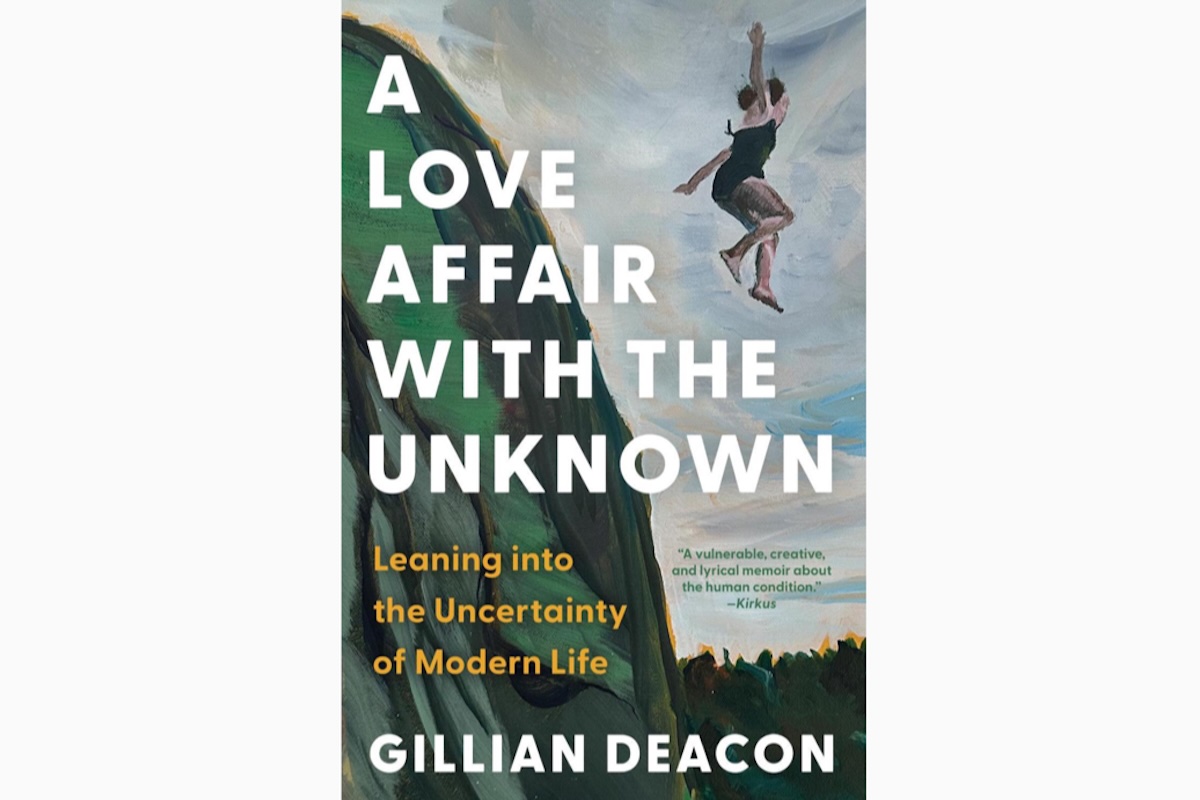
An excerpt from A Love Affair with the Unknown by Gill Deacon. Get your copy here.
My own strategy to overcome fear has been to “feel the fear and do it anyway,” as the popular saying goes. But I realize now that I have misinterpreted the mantra, focusing only on the second half: do it anyway. I have always thought that leaping into action is to fully embrace life; that being impulsive and assuming the posture of confidence is the secret. A fake-it-till-you-make-it approach to being—or at least appearing to be—fearless.
I have a long-standing love of jumping off rocks and cliffs. Not the twenty-five-metre stuff of David Blaine spectacles, of course. But a six- or even eight-metre jump into deep water is something to which I will always say (a nervous but determined) yes. A yes to experiencing seconds of free fall that are jam-packed with so much exhilaration as to feel like minutes; a hell, yes to conquering the pounding heart and ripples of full-body heat telling me to back away from the rock’s edge. But I can’t listen to that fear. I need to defy it. I need to prove it wrong and show myself that it can’t defeat me, limit me, hold me back from that fleeting rush of a carefree plummet. There is nothing more powerful than that fraction of a second when I override what is surely a sensible, evolutionarily sound, protective urge to stay back from the edge—and I leap. I do it anyway. Crashing into the safe embrace of the cool water, pointed feet flapping like every baby held over a bathtub, I feel vindicated. And a little bit stronger every time it happens.
For most of my life, I operated on the principle that if I do the things that most people are afraid of, then I must be brave. Striking a devil-may-care pose of bold spunkiness, my audacity speaks for itself. See? I’m doing things that terrify me, therefore I must be fearless and powerful. Diving in as a posture of daring. But I see things differently now; more completely. In my haste to move impulsively into the action that I feared—to do it anyway—I was racing past the first half of that boldness directive, the part that matters most: feel the fear.
Doing something courageous without reframing how we think about sitting in difficult emotions like fear, pain, and uncertainty is just a flex. Feeling the fear, getting close to it, sitting with it, identifying it, naming it, honouring it, tracing its energetic path through your body—that is the part that makes you strong. Feeling the fear and doing it anyway is a two-step process, and I’ve only recently come to see how much I’ve skipped the first step.
The other, perhaps even more critical, aspect of Blaine’s training is to cultivate a confident mindset. That’s where the real magic happens—in his head. I think this is the life lesson we can all take from the radical stuntman. How has Blaine changed his mental approach to fear and discomfort? He accepts everything the way it is. “You can’t fight the force of what is happening,” he told Rubin. “Whatever feels frightening about the uncertainties we face, we know that panicking about our inability to handle it never helps. You need to have faith that you can handle it and try to stay calm.”
Using the information and knowledge he gathers through his research and practice, Blaine bolsters his faith that he can handle whatever happens. It’s a faith that drives everything he does, and a confidence he wants the rest of us to think about. “I believe in the idea that we can all push past what we believe is possible.”
On the surface, Blaine’s call to confidence might sound like an empty you-can-do-it pep rally platitude. But it is more than a bromide; his conviction that we can all handle more than we think we can is rooted in deeper thought, which for him stems from a profound loss. Blaine was raised by a single mother who died when he was twenty-one. “When my mother was dying, she looked at the beauty in everything. She made death very poetic and beautiful. It was the greatest gift she gave me, she made me not afraid of the unknown.”
If we put the ear in fear, as it were, what stories do we listen to it telling us? Most often they are tales of what we think might happen; in other words catastrophizing. Psychologists call that anticipatory anxiety—what’s sometimes referred to as “bleeding before you are cut.” We fear aging for how much pain it may cause us, both physical and emotional; we fear the AI revolution will take away our jobs and our autonomy; some of us fear crowds, while others fear being alone. Whatever fear cripples you at any given time, if you stop and feel it more clearly, its story will emerge.
We’d love to hear from you! Please send us your suggestions for future articles. And if you’re a writer, please see our writer’s submissions page for details.