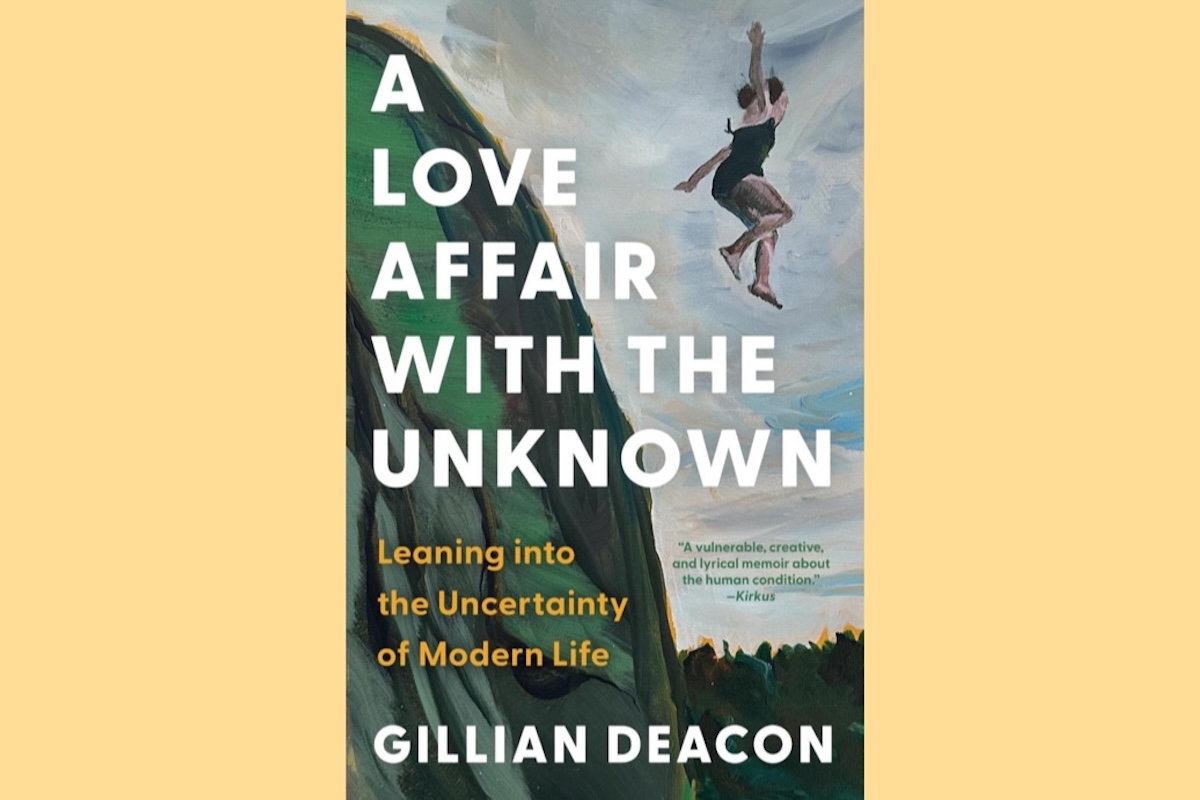
Excerpted from A Love Affair with the Unknown: Leaning into the Uncertainty of Modern Life by Gillian Deacon, 2026, published by House of Anansi. Reprinted with permission from the publisher.
Uncertainty is the only certainty there is, and knowing how to live with insecurity is the only security.
John Allen Paulos
In 1991, with just four weeks to go before defending her doctoral dissertation on early childhood linguistic development, Anne Lederer bid farewell to her fellow PhD candidates at the University of Pennsylvania and dropped out of academia. She moved to Billings, Montana, got married, and started a new chapter. Her brother, Howard Lederer, was a professional poker player—a game he and his siblings had learned at home and played for fun when they were younger. After her move to Montana, Howard encouraged Anne to take poker playing more seriously. He sent her some books on techniques, coached her on the rules and strategy over the telephone, and loaned her $2,400 to get her game going.
She got her game going, alright. Today, Annie Duke is known as the Duchess of Poker. By the time she retired from playing professionally in 2012, she had racked up dozens of victories at various tournaments—including the World Series of Poker Tournament of Champions—and her life- time winnings totalled well over $4 million. She is close to the top of the list of the most successful female poker players in history. (She also returned to the University of Pennsylvania in 2022 to complete her PhD.)
Duke is a self-described uncertainty evangelist. Uncertainty is of course fundamental to the game of poker—laying your chips on the table based entirely on instinct and the likelihood of an opponent’s bluff is a high-stakes play, a great risk that comes with no guarantees. When that river card is flipped, and fate weighs in on whatever calculations and assumptions led to your bet, the wheel of fortune can spin as easily for you as against you. Duke’s story perhaps makes earning millions at the poker table sound easy, but of course the more accurate picture of seeking one’s fortune in cards is filled with many smaller victories and a huge amount of crushing debt and loss. Gambling can be as addictive as it is uncertain.
Poker, as easy as it might appear, is an incredibly compli- cated game. “The more you learn about poker,” Duke said in an interview, “the more you realize that you don’t know very much about the game, so there’s an expansion of your knowledge of what you don’t know as you go through.” The more you realize how little you know, she argues, the better you get.
That seems like unlikely humility from someone who has mastered the game, but here, too, humility is a critical strength. Just as the arrogance of believing life should follow a plan that best suits us renders us less capable of managing change, and the grounded humility of understanding our place in nature is essential for navigating the climate crisis, being humble may well be the reason for Duke’s success at the poker table. The feeling that the cards are in their favour and Lady Luck has their back has led many a card player to a haunting defeat, as the hubris of certainty overrides grounded patience and cool-headed strategy.
There is a growing body of research on the psychology of humility, as a character trait and in terms of its ties to well-being. Humility requires an accurate assessment of one’s character, an awareness of one’s limitations, keeping one’s achievements in perspective, and appreciating other people and other ideas. Researchers refer to someone who exhibits humility as having low “self-focus” and high “other-focus.” Studies suggest that people who are more humble tend to enjoy better physical and mental health than individuals who are less humble.
I had a lesson in the importance of humility on a family vacation in California, when my adolescent middle son asked to take a surf lesson. All three of my boys are lean, agile athletes for whom mastering sports comes easily; the kind of people who make coordination look obvious, and bull’s eyes and smooth landings seem inevitable. They take to new activities quickly, with instincts like Hermes; teaching those boys to ride a bicycle without training wheels took less than an hour. When it comes to grace and strength, my sons do not—to be clear—take after their mother.
Lulled by the charms of surf-town culture and the groovy ease with which surfers up and down the beach rode shim- mering foamy crests of one glorious wave after another, I decided I would join in—forgetting which parent had gifted my children their athletic genes. I had the core of a long- time yogi, I reassured myself with unwarranted confidence as I straddled the wide board, and the balance to go with it.
The tanned dude teaching the lesson imparted what sounded like easy advice for simple steps to follow: Paddle. Pop up. Lean in. Don’t look down. There were no balls involved, no hand-eye coordination required. This might be my sport, I reasoned as I paddled a few feet offshore. In a burst of wild overconfidence, I had a sudden fantasy of all the surfing trips we could take as a family, chasing waves and hanging ten together—until the reality of my current windmill-armed fiasco drowned those delusions. I was too busy assuming I could do this incredibly hard thing to pay attention to all the steps I needed to take in order to pull it off. Possibly the most futile undertaking of my adult life, my surfing lesson was brief and unforgettable: an inelegant series of spectacular, flailing spills in knee-deep waves. A textbook kook, in true surfer parlance. I remain humbled by all that I don’t know, and will likely never know, about how to surf.
Why does pride usually come before a fall? When we allow ourselves to feel certainty, we become closed-minded. Assumptions shut us off from other possibilities, from learn- ing or observing new information, from staying curious and updating our beliefs to adapt to change. When we lean on certainty, we aren’t motivated to be resourceful.
Metaphorically and physically, surfing is the ultimate manifestation of navigating uncertainty. Paying attention to the immediacy of the moment, accepting what comes with humility and curiosity, and letting go of assumptions about what should happen. That’s the chestnut of medi- tative wisdom from mindfulness pioneer Jon Kabat-Zinn. A professor emeritus at the University of Massachusetts Medical School, Kabat-Zinn is the founder of the widely prescribed Mindfulness Based Stress Reduction (MBSR) program, and the author of fifteen books that have been translated into forty-five languages. Of all his lasting accomplishments, he is perhaps best known for the simple axiom of modern living that distills everything he teaches into a single sentence: “You can’t stop the waves, but you can learn to surf.”
And that’s what this entire inquiry around handling uncertainty all boils down to, isn’t it? Figuring out how to stay emotionally afloat in a tsunami of change.
We’d love to hear from you! Please send us your suggestions for future articles. And if you’re a writer, please see our writer’s submissions page for details.